
SLIDING WINDOW PROTOCOLS
In the previous protocols, data frames were transmitted in one direction only. In most practical situations, there is a need for transmitting data in both directions. One way of achieving full-duplex data transmission is to have two separate communication channels and use each one for simplex data traffic (in different directions). If this is done, we have two separate physical circuits, each with a ‘‘forward’’ channel (for data) and a ‘‘reverse’’ channel (for acknowledgements). In both cases the bandwidth of the reverse channel is almost entirely wasted. In effect, the user is paying for two circuits but using only the capacity of one.
A better idea is to use the same circuit for data in both directions. After all, in protocols 2 and 3 it was already being used to transmit frames both ways, and the reverse channel has the same capacity as the forward channel. In this model the data frames from A to B are intermixed with the acknowledgement frames from A to B. By looking at the kind field in the header of an incoming frame, the receiver can tell whether the frame is data or acknowledgement.
Although interleaving data and control frames on the same circuit is an improvement over having two separate physical circuits, yet another improvement is possible. When a data frame arrives, instead of immediately sending a separate control frame, the receiver restrains itself and waits until the network layer passes it the next packet. The acknowledgement is attached to the outgoing data frame (using the ack field in the frame header). In effect, the acknowledgement gets a free ride on the next outgoing data frame. The technique of temporarily delaying Outgoing acknowledgements so that they can be hooked onto the next outgoing data frame is known as piggybacking.
The principal advantage of using piggybacking over having distinct acknowledgement frames is a better use of the available channel bandwidth. The ack field in the frame header costs only a few bits, whereas a separate frame would need a header, the acknowledgement, and a checksum. In addition, fewer frames sent means fewer ‘‘frame arrival’’ interrupts, and perhaps fewer buffers in the receiver, depending on how the receiver’s software is organized. In the next protocol to be examined, the piggyback field costs only 1 bit in the frame header. It rarely costs more than a few bits.
However, piggybacking introduces a complication not present with separate acknowledgements. How long should the data link layer wait for a packet onto which to piggyback the acknowledgement? If the data link layer waits longer than the sender’s timeout period, the frame will be retransmitted, defeating the whole purpose of having acknowledgements. If the data link layer were an oracle and could foretell the future, it would know when the next network layer packet was going to come in and could decide either to wait for it or send a separate acknowledgement immediately, depending on how long the projected wait was going to be.
Of course, the data link layer cannot foretell the future, so it must resort to some ad hoc scheme, such as waiting a fixed number of milliseconds. If a new packet arrives quickly, the acknowledgement is piggybacked onto it; otherwise, if no new packet has arrived by the end of this time period, the data link layer just sends a separate acknowledgement frame.
The next three protocols are bidirectional protocols that belong to a class called sliding window protocols. The three differ among themselves in terms of efficiency, complexity, and buffer requirements, as discussed later. In these, as in all sliding window protocols, each outbound frame contains a sequence number, ranging from 0 up to some maximum. The maximum is usually 2n − 1 so the sequence number fits exactly in an n-bit field. The stop-and-wait sliding window protocol uses n = 1, restricting the sequence numbers to 0 and 1, but more sophisticated versions can use arbitrary n.
The essence of all sliding window protocols is that at any instant of time, the sender maintains a set of sequence numbers corresponding to frames it is permitted to send. These frames are said to fall within the sending window. Similarly, the receiver also maintains a receiving window corresponding to the set of frames it is permitted to accept. The sender’s window and the receiver’s window need not have the same lower and upper limits or even have the same size. In some protocols they are fixed in size, but in others they can grow or shrink over the course of time as frames are sent and received.
Although these protocols give the data link layer more freedom about the order in which it may send and receive frames, we have definitely not dropped the requirement that the protocol must deliver packets to the destination network layer in the same order they were passed to the data link layer on the sending machine. Nor have we changed the requirement that the physical communication channel is ‘‘wire-like,’’ that is, it must deliver all frames in the order sent. The sequence numbers within the sender’s window represent frames that have been sent or can be sent but are as yet not acknowledged. Whenever a new packet arrives from the network layer, it is given the next highest sequence number, and the upper edge of the window is advanced by one. When an acknowledgement comes in, the lower edge is advanced by one. In this way the window continuously maintains a list of unacknowledged frames. Figure shows an example.
Since frames currently within the sender’s window may ultimately be lost or damaged in transit, the sender must keep all these frames in its memory for possible retransmission. Thus, if the maximum window size is n, the sender needs n buffers to hold the unacknowledged frames. If the window ever grows to its maximum size, the sending data link layer must forcibly shut off the network layer until another buffer becomes free. The receiving data link layer’s window corresponds to the frames it may accept. Any frame falling outside the window is discarded without comment.
When a frame whose sequence number is equal to the lower edge of the window is received, it is passed to the network layer, an acknowledgement is generated, and the window is rotated by one. Unlike the sender’s window, the receiver’s window always remains at its initial size. Note that a window size of 1 means that the data link layer only accepts frames in order, but for larger windows this is not so. The network layer, in contrast, is always fed data in the proper order, regardless of the data link layer’s window size.

Figure. A sliding window of size 1, with a 3-bit sequence number.
(a) Initially. (b) After the first frame has been sent. (c) After the first frame has been received. (d) After the first acknowledgement has been received.
Figure shows an example with a maximum window size of 1. Initially, no frames are outstanding, so the lower and upper edges of the sender’s window are equal, but as time go on, the situation progresses as shown.
3.1 A ONE-BIT SLIDING WINDOW PROTOCOL
Before tackling the general case, let us first examine a sliding window protocol with a maximum window size of 1. Such a protocol uses stop-and-wait since the sender transmits a frame and waits for its acknowledgement before sending the next one.
Figure depicts such a protocol. Like the others, it starts out by defining some variables. Next3frame3to3send tells which frame the sender is trying to send. Similarly, frame3expected tells which frame the receiver is expecting. In both cases, 0 and 1 are the only possibilities. Under normal circumstances, one of the two data link layers goes first and transmits the first frame. In other words, only one of the data link layer programs should contain the to3physical3layer and start3timer procedure calls outside the main loop. In the event that both data link layers start off simultaneously
/* Protocol 4 (sliding window) is bidirectional. */
#define MAX3SEQ 1 /* must be 1 for protocol 4 */
typedef enum {frame3arrival, cksum3err, timeout} event3type;
#include "protocol.h"
void protocol4 (void)
{
seq3nr next3frame3to3send; /* 0 or 1 only */
seq3nr frame3expected; /* 0 or 1 only */
frame r, s; /* scratch variables */
packet buffer; /* current packet being sent */
event3type event;
next3frame3to3send = 0; /* next frame on the outbound stream */
frame3expected = 0; /* frame expected next */
from3network3layer(&buffer); /* fetch a packet from the network layer */
s.info = buffer; /* prepare to send the initial frame */
s.seq = next3frame3to3send; /* insert sequence number into frame */
s.ack = 1 − frame3expected; /* piggybacked ack */
to3physical3layer(&s); /* transmit the frame */
start3timer(s.seq); /* start the timer running */
while (true) {
wait3for3event(&event); /* frame3arrival, cksum3err, or timeout */
if (event == frame3arrival) { /* a frame has arrived undamaged. */
from3physical3layer(&r); /* go get it */
if (r.seq == frame3expected) { /* handle inbound frame stream. */
to3network3layer(&r.info); /* pass packet to network layer */
inc(frame3expected); /* invert seq number expected next */
}
if (r.ack == next3frame3to3send) { /* handle outbound frame stream. */
stop3timer(r.ack); /* turn the timer off */
from3network3layer(&buffer); /* fetch new pkt from network layer */
inc(next3frame3to3send); /* invert sender’s sequence number */
}
}
s.info = buffer; /* construct outbound frame */
s.seq = next3frame3to3send; /* insert sequence number into it */
s.ack = 1 − frame3expected; /* seq number of last received frame */
to3physical3layer(&s); /* transmit a frame */
start3timer(s.seq); /* start the timer running */
}
}
Figure A 1-bit sliding window protocol.
peculiar situation arises, as discussed later. The starting machine fetches the first packet from its network layer, builds a frame from it, and sends it. When this (or any) frame arrives, the receiving data link layer checks to see if it is a duplicate, just as in protocol 3. If the frame is the one expected, it is passed to the network layer and the receiver’s window is slid up.
The acknowledgement field contains the number of the last frame received without error. If this number agrees with the sequence number of the frame the sender is trying to send, the sender knows it is done with the frame stored in buffer and can fetch the next packet from its network layer. If the sequence number disagrees, it must continue trying to send the same frame. Whenever a frame is received, a frame is also sent back.
Now let us examine protocol 4 to see how resilient it is to pathological scenarios. Assume that computer A is trying to send its frame 0 to computer B and that B is trying to send its frame 0 to A. Suppose that A sends a frame to B, but A’s timeout interval is a little too short. Consequently, A may time out repeatedly, sending a series of identical frames, all with seq = 0 and ack = 1.When the first valid frame arrives at computer B, it will be accepted and frame 3 expected will be set to 1. All the subsequent frames will be rejected because B is now expecting frames with sequence number 1, not 0. Furthermore, since all the duplicates have ack = 1 and B is still waiting for an acknowledgement of 0, B will not fetch a new packet from its network layer.
After every rejected duplicate comes in, B sends A frame containing seq = 0 and ack = 0. Eventually, one of these arrives correctly at A, causing A to begin sending the next packet. No combination of lost frames or premature timeouts can cause the protocol to deliver duplicate packets to either network layer, to skip a packet, or to deadlock.
However, a peculiar situation arises if both sides simultaneously send an initial packet. This synchronization difficulty is illustrated by Fig. In part (a), the normal operation of the protocol is shown. In (b) the peculiarity is illustrated. If B waits for A’s first frame before sending one of its own, the sequence is as shown in (a), and every frame is accepted. However, if A and B simultaneously initiate communication, their first frames cross, and the data link layers then get into situation (b). In (a) each frame arrival brings a new packet for the network layer; there are no duplicates. In (b) half of the frames contain duplicates, even though there are no transmission errors. Similar situations can occur as a result of premature timeouts, even when one side clearly starts first. In fact, if multiple premature timeouts occur, frames may be sent three or more times.
3.2 A PROTOCOL USING GO BACK N
Until now we have made the tacit assumption that the transmission time required for a frame to arrive at the receiver plus the transmission time for the acknowledgement to come back is negligible. Sometimes this assumption is clearly.

Figure. Two scenarios for protocol 4. (a) Normal case. (b) Abnormal case. The notation is (seq, ack, packet number). An asterisk indicates where a network layer accepts a packet.
In these situations the long round-trip time can have important implications
for the efficiency of the bandwidth utilization. As an example, consider a 50-kbps satellite channel with a 500-msec round-trip propagation delay. Let us imagine trying to use protocol 4 to send 1000-bit frames via the satellite. At t = 0 the sender starts sending the first frame. At t = 20 msec the frame has been completely sent. Not until t = 270 msec has the frame fully arrived at the receiver, and not until t = 520 msec has the acknowledgement arrived back at the sender, under the best of circumstances (no waiting in the receiver and a short acknowledgement frame). This means that the sender was blocked during 500/520 or 96 percent of the time. In other words, only 4 percent of the available bandwidth was used. Clearly, the combination of a long transit time, high bandwidth, and short frame length is disastrous in terms of efficiency. The problem described above can be viewed as a consequence of the rule requiring a sender to wait for an acknowledgement before sending another frame.
If we relax that restriction, much better efficiency can be achieved. Basically, the solution lies in allowing the sender to transmit up to w frames before blocking, instead of just 1. With an appropriate choice of w the sender will be able to continuously transmit frames for a time equal to the round-trip transit time without filling up the window. In the example above, w should be at least 26. The sender begins sending frame 0 as before. By the time it has finished sending 26 frames, at t = 520, the acknowledgement for frame 0 will have just arrived. Thereafter, acknowledgements arrive every 20 msec, so the sender always gets permission to continue just when it needs it. At all times, 25 or 26 unacknowledged frames are outstanding. Put in other terms, the sender’s maximum window size is 26. The need for a large window on the sending side occurs whenever the product of bandwidth × round-trip-delay is large. If the bandwidth is high, even for a moderate delay, the sender will exhaust its window quickly unless it has a large window. If the delay is high (e.g., on a geostationary satellite channel), the sender will exhaust its window even for a moderate bandwidth. The product of these two factors basically tells what the capacity of the pipe is, and the sender needs the ability to fill it without stopping in order to operate at peak efficiency.
This technique is known as pipelining. If the channel capacity is b bits/sec, the frame size l bits, and the round-trip propagation time R sec, the time required to transmit a single frame is l /b sec. After the last bit of a data frame has been sent, there is a delay of R /2 before that bit arrives at the receiver and another delay of at least R /2 for the acknowledgement to come back, for a total delay of R. In stop-and-wait the line is busy for l /b and idle for R, giving line utilization = l /(l + bR) If l < bR, the efficiency will be less than 50 percent. Since there is always a nonzero delay for the acknowledgement to propagate back, pipelining can, in principle, be used to keep the line busy during this interval, but if the interval is small, the additional complexity is not worth the trouble. Pipelining frames over an unreliable communication channel raises some serious issues. First, what happens if a frame in the middle of a long stream is damaged or lost? Large numbers of succeeding frames will arrive at the receiver before the sender even finds out that anything is wrong. When a damaged frame arrives at the receiver, it obviously should be discarded, but what should the receiver do with all the correct frames following it? Remember that the receiving data link layer is obligated to hand packets to the network layer in sequence. In Fig. we see the effects of pipelining on error recovery. We will now examine it in some detail.
Two basic approaches are available for dealing with errors in the presence of pipelining. One way, called go back n, is for the receiver simply to discard all subsequent frames, sending no acknowledgements for the discarded frames. This strategy corresponds to a receive window of size 1. In other words, the data link layer refuses to accept any frame except the next one it must give to the network layer. If the sender’s window fills up before the timer runs out, the pipeline will begin to empty. Eventually, the sender will time out and retransmit all unacknowledged frames in order, starting with the damaged or lost one. This approach can waste a lot of bandwidth if the error rate is high.
In Fig. we see go back n for the case in which the receiver’s window is large. Frames 0 and 1 are correctly received and acknowledged. Frame 2, however, is damaged or lost. The sender, unaware of this problem, continues to send frames until the timer for frame 2 expires. Then it backs up to frame 2 and starts all over with it, sending 2, 3, 4, etc. all over again.
The other general strategy for handling errors when frames are pipelined is called selective repeat.
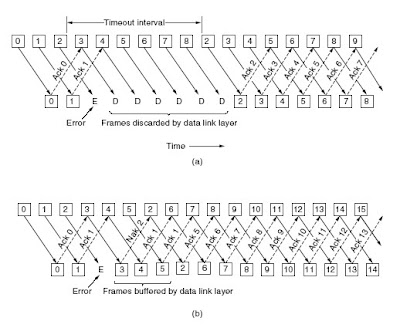
Figure. Pipelining and error recovery. Effect of an error when
(a) Receiver’s window size is 1 and (b) receiver’s window size is large.
When it is used, a bad frame that is received is discarded, but good frames received after it are buffered. When the sender times out, only the oldest unacknowledged frame is retransmitted. If that frame arrives correctly, the receiver can deliver to the network layer, in sequence, all the frames it has buffered. Selective repeat is often combined with having the receiver send a negative acknowledgement (NAK) when it detects an error, for example, when it receives a checksum error or a frame out of sequence. NAKs stimulate retransmission before the corresponding timer expires and thus improve performance.
In Fig. (b), frames 0 and 1 are again correctly received and acknowledged and frame 2 is lost. When frame 3 arrives at the receiver, the data link layer there notices that is has missed a frame, so it sends back a NAK for 2 but buffers 3.When frames 4 and 5 arrive, they, too, are buffered by the data link layer instead of being passed to the network layer. Eventually, the NAK 2 gets back to the sender, which immediately resends frame 2. When that arrives, the data link layer now has 2, 3, 4, and 5 and can pass all of them to the network layer in the correct.
It can also acknowledge all frames up to and including 5, as shown in the figure. If the NAK should get lost, eventually the sender will time out for frame 2 and send it (and only it) of its own accord, but that may be a quite a while later. In effect, the NAK speeds up the retransmission of one specific frame.
Selective repeat corresponds to a receiver window larger than 1. Any frame within the window may be accepted and buffered until all the preceding ones have been passed to the network layer. This approach can require large amounts of data link layer memory if the window is large.
These two alternative approaches are trade-offs between bandwidth and data link layer buffer space. Depending on which resource is scarcer, one or the other can be used. Figure 3-17 shows a pipelining protocol in which the receiving data link layer only accepts frames in order; frames following an error are discarded. In this protocol, for the first time we have dropped the assumption that the network layer always has an infinite supply of packets to send. When the network layer has a packet it wants to send, it can cause a network3layer3ready event to
happen. However, to enforce the flow control rule of no more than MAX3SEQ unacknowledged frames outstanding at any time, the data link layer must be able to keep the network layer from bothering it with more work. The library proceduresenable3network3layer and disable3network3layer do this job.
Note that a maximum of MAX3SEQ frames and not MAX3SEQ + 1 frame
may be outstanding at any instant, even though there are MAX3SEQ + 1 distinct sequence numbers: 0, 1, 2, . . . , MAX3SEQ. To see why this restriction is required, consider the following scenario with MAX3SEQ = 7.
1. The sender sends frames 0 through 7.
2. A piggybacked acknowledgement for frame 7 eventually comes back to the sender.
3. The sender sends another eight frames, again with sequence numbers 0 through 7.
4. Now another piggybacked acknowledgement for frame 7 comes in.
The question is this: Did all eight frames belonging to the second batch arrive successfully, or did all eight get lost (counting discards following an error as lost)?
In both cases the receiver would be sending frame 7 as the acknowledgement. The sender has no way of telling. For this reason the maximum number of outstanding frames must be restricted to MAX3SEQ. Although protocol 5 does not buffer the frames arriving after an error, it does not escape the problem of buffering altogether. Since a sender may have to retransmit all the unacknowledged frames at a future time, it must hang on to all transmitted frames until it knows for sure that they have been accepted by the receiver. When an acknowledgement comes in for frame n, frames n − 1, n − 2, and so on are also automatically acknowledged. This property is especially important when some of the previous acknowledgement-bearing frames were lost or garbled. Whenever any acknowledgement comes in, the data link layer checks to see if any buffers can now be released. If buffers can be released (i.e., there is some room available in the window), a previously blocked network layer can now be allowed to cause more network3layer3ready events.
For this protocol, we assume that there is always reverse traffic on which to piggyback acknowledgements. If there is not, no acknowledgements can be sent. Protocol 4 does not need this assumption since it sends back one frame every time it receives a frame, even if it has just already sent that frame. In the next protocol we will solve the problem of one-way traffic in an elegant way. Because protocol 5 has multiple outstanding frames, it logically needs multiple timers, one per outstanding frame. Each frame times out independently of all the other ones. All of these timers can easily be simulated in software, using a single hardware clock that causes interrupts periodically. The pending timeouts form a linked list, with each node of the list telling the number of clock ticks until the timer expires, the frame being timed, and a pointer to the next node.
Figure. Simulation of multiple timers in software.
As an illustration of how the timers could be implemented, consider the example of Fig. (a). Assume that the clock ticks once every 100 msec. Initially, the real time is 10:00:00.0; three timeouts are pending, at 10:00:00.5, 10:00:01.3, and 10:00:01.9. Every time the hardware clock ticks, the real time is updated and the tick counter at the head of the list is decremented. When the tick counter becomes zero, a timeout is caused and the node is removed from the list, as shown in Fig. (b). Although this organization requires the list to be scanned when start3timer or stop3timer is called, it does not require much work per tick. In protocol 5, both of these routines have been given a parameter, indicating which frame is to be timed.
3.3 A PROTOCOL USING SELECTIVE REPEAT
Protocol 5 works well if errors are rare, but if the line is poor, it wastes a lot of bandwidth on retransmitted frames. An alternative strategy for handling errors is to allow the receiver to accept and buffer the frames following a damaged or lost one. Such a protocol does not discard frames merely because an earlier frame was damaged or lost.
In this protocol, both sender and receiver maintain a window of acceptable sequence numbers. The sender’s window size starts out at 0 and grows to some predefined maximum, MAX3SEQ. The receiver’s window, in contrast, is always fixed in size and equal to MAX3SEQ. The receiver has a buffer reserved for each sequence number within its fixed window. Associated with each buffer is a bit (arrived) telling whether the buffer is full or empty. Whenever a frame arrives, its sequence number is checked by the function between to see if it falls within the window. If so and if it has not already been received, it is accepted and stored.
This action is taken without regard to whether or not it contains the next packet expected by the network layer. Of course, it must be kept within the data link layer and not passed to the network layer until all the lower-numbered frames have already been delivered to the network layer in the correct order. A protocol using this algorithm is given in Fig.
Nonsequential receive introduces certain problems not present in protocols in which frames are only accepted in order. We can illustrate the trouble most easily with an example. Suppose that we have a 3-bit sequence number, so that the sender is permitted to transmit up to seven frames before being required to wait for an acknowledgement. Initially, the sender’s and receiver’s windows are as shown in Fig. (a). The sender now transmits frames 0 through 6. The receiver’s window allows it to accept any frame with sequence number between 0 and 6 inclusive. All seven frames arrive correctly, so the receiver acknowledges them and advances its window to allow receipt of 7, 0, 1, 2, 3, 4, or 5, as shown in Fig. (b). All seven buffers are marked empty.
It is at this point that disaster strikes in the form of a lightning bolt hitting the telephone pole and wiping out all the acknowledgements. The sender eventually times out and retransmits frame 0. When this frame arrives at the receiver, a check is made to see if it falls within the receiver’s window. Unfortunately, in Fig. (b) Frame 0 is within the new window, so it will be accepted. The receiver sends a piggybacked acknowledgement for frame 6, since 0 through 6 have been received.
The sender is happy to learn that all its transmitted frames did actually arrive correctly, so it advances its window and immediately sends frames 7, 0, 1, 2, 3, 4, and 5. Frame 7 will be accepted by the receiver and its packet will be passed directly to the network layer. Immediately thereafter, the receiving data link layer checks to see if it has a valid frame 0 already, discovers that it does, and passes the embedded packet to the network layer. Consequently, the network layer gets an incorrect packet, and the protocol fails. The essence of the problem is that after the receiver advanced its window, the new range of valid sequence numbers overlapped the old one. Consequently, the following batch of frames might be either duplicates (if all the acknowledgements were lost) or new ones (if all the acknowledgements were received).
The poor receiver has no way of distinguishing these two cases. The way out of this dilemma lies in making sure that after the receiver has advanced its window, there is no overlap with the original window. To ensure that there is no overlap, the maximum window size should be at most half the range of the sequence numbers, as is done in Fig. (c) and Fig. (d). For example, if 4 bits are used for sequence numbers, these will range from 0 to 15. Only eight unacknowledged frames should be outstanding at any instant. That way, if the receiver has just accepted frames 0 through 7 and advanced its window to permit acceptance of frames 8 through 15, it can unambiguously tell if subsequent frames are retransmissions (0 through 7) or new ones (8 through 15). In general, the window size for protocol 6 will be (MAX3SEQ + 1)/2. Thus, for 3- bit sequence numbers, the window size is four. An interesting question is: How many buffers must the receiver have?
Under no conditions will it ever accept frames whose sequence numbers are below the lower edge of the window or frames whose sequence numbers are above the upper edge of the window. Consequently, the number of buffers needed is equal to the window size, not to the range of sequence numbers. In the above example of a 4-bit sequence number, eight buffers, numbered 0 through 7, are needed. When frame i arrives, it is put in buffer i mod 8. Notice that although i and (i + 8) mod 8 are ‘‘competing’’ for the same buffer, they are never within the window at the same time, because that would imply a window size of at least 9. For the same reason, the number of timers needed is equal to the number of buffers, not to the size of the sequence space.
Effectively, a timer is associated with each buffer. When the timer runs out, the contents of the buffer are retransmitted. In protocol 5, there is an implicit assumption that the channel is heavily loaded. When a frame arrives, no acknowledgement is sent immediately. Instead, the acknowledgement is piggybacked onto the next outgoing data frame. If the reverse traffic is light, the acknowledgement will be held up for a long period of time. If there is a lot of traffic in one direction and no traffic in the other direction, only MAX3SEQ packets are sent, and then the protocol blocks, which is why we had to assume there was always some reverse traffic.
In protocol 6 this problem is fixed. After an in-sequence data frame arrives, an auxiliary timer is started by start3ack3timer. If no reverse traffic has presented itself before this timer expires, a separate acknowledgement frame is sent. An interrupt due to the auxiliary timer is called an ack3timeout event. With this arrangement, one-directional traffic flow is now possible because the lack of reverse data frames onto which acknowledgements can be piggybacked is no longer
(a) Initial situation with a window of size seven. (b) After seven an frames have been sent and received but not acknowledged. (c) Initial situation with a window size of four. (d) After four frames have been sent and received but not acknowledged. Only one auxiliary timer exists, and if start3ack3timer is called while the timer is running, it is reset to a full acknowledgement timeout interval.
It is essential that the timeout associated with the auxiliary timer be appreciably shorter than the timer used for timing out data frames. This condition is required to make sure a correctly received frame is acknowledged early enough that the frame’s retransmission timer does not expire and retransmit the frame. Protocol 6 uses a more efficient strategy than protocol 5 for dealing with errors. Whenever the receiver has reason to suspect that an error has occurred, it sends a negative acknowledgement (NAK) frame back to the sender. Such a frame is a request for retransmission of the frame specified in the NAK. There are two cases when the receiver should be suspicious: a damaged frame has arrived or a frame other than the expected one arrived (potential lost frame). To avoid making multiple requests for retransmission of the same lost frame, the receiver should keep track of whether a NAK has already been sent for a given frame. The variable no3nak in protocol 6 is true if no NAK has been sent yet for frame3expected. If the NAK gets mangled or lost, no real harm is done, since the sender wills eventually time out and retransmits the missing frame anyway. If the wrong frame arrives after a NAK has been sent and lost, no3nak will be true and the auxiliary timer will be started. When it expires, an ACK will be sent to resynchronize the sender to the receiver’s current status.
In some situations, the time required for a frame to propagate to the destination, be processed there, and have the acknowledgement come back is (nearly) constant. In these situations, the sender can adjust its timer to be just slightly larger than the normal time interval expected between sending a frame and receiving its acknowledgement. However, if this time is highly variable, the sender is faced with the choice of either setting the interval to a small value (and risking unnecessary retransmissions), or setting it to a large value (and going idle for a long
period after an error).
Both choices waste bandwidth. If the reverse traffic is sporadic, the time before acknowledgement will be irregular, being shorter when there is reverse traffic and longer when there is not. Variable processing time within the receiver can also be a problem here. In general, whenever the standard deviation of the acknowledgement interval is small compared to the interval itself, the timer can be set ‘‘tight’’ and NAKs are not useful. Otherwise the timer must be set ‘‘loose,’’ to avoid unnecessary retransmissions, but NAKs can appreciably speed up retransmission of lost or damaged frames. Closely related to the matter of timeouts and NAKs is the question of determining which frame caused a timeout. In protocol 5, it is always ack3expected, because it is always the oldest. In protocol 6, there is no trivial way to determine who timed out. Suppose that frames 0 through 4 have been transmitted, meaning that the list of outstanding frames is 01234, in order from oldest to youngest.
Now imagine that 0 times out, 5 (a new frame) is transmitted, 1 times out, 2 times out, and 6 (another new frame) is transmitted. At this point the list of outstanding frames is 3405126, from oldest to youngest. If all inbound traffic (i.e., acknowledgement- bearing frames) is lost for a while, the seven outstanding frames will time out in that order.
To keep the example from getting even more complicated than it already is, we have not shown the timer administration. Instead, we just assume that the variable oldest3frame is set upon timeout to indicate which frame timed out.
3.3.1 A PROBLEM WITH SELECTIVE REPEAT
Suppose we use 3 bits to represent the sequence numbers (0..7).
Now, in order:
• Sender sends frames 0...6.
• All arrive correctly into receiver’s window 0...6, receiver advances its window to 7, 0, 1, 5 and acknowledges the frames.
• A small disaster occurs and acknowledgements are not received.
• The sender times out and resends frame 0.
• The receiver gets frame 0, which is within its window and says thanks. The receiver acknowledges for frame 6 as it is still waiting on 7.
• Sender now sends new frames 7,0,1,...,5.
• Frame 7 is received and frames 7 and (the duplicated) 0 go off to the network layer. Blah!
The Solution: make window sizes half the size of the maximum sequence number.


